DDOT prioritizes cycling activists over general public. Again.
DDOT’s Sham Public Engagement Process – Open Letter – Save Conn Ave 12-21-25
Open Letter to DDOT Regarding Sham Public Engagement Process

December 21, 2025
Director Kershbaum and Associate Director Kanagy:
We at Save Connecticut Ave are writing to express serious concerns about DDOT’s public engagement process for the Strategic Bikeways Plan. DDOT has stated that this process is the final step before releasing a draft plan for public comment. Given that the Strategic Bikeways Plan will shape District transportation policy for years and will be incorporated into a revised MoveDC framework, it is essential that the process be balanced, inclusive, and credible. We have been following the process closely and believe that it has been none of those things.
DDOT has structured this process to give organized cycling advocates the first and most influential role in developing the Bikeways Plan, with the broader public left only to react afterward. This approach is flawed, inefficient, and guaranteed to generate future conflict and ill will.
Several aspects of the current process illustrate these problems:
- DDOT began the process by soliciting cyclist input to update the 2021 MoveDC bike maps. The broader public will only be engaged afterward. This reverses a fair planning sequence and forces residents to react to and oppose proposals that have already gained institutional momentum.
- In our experience, once bike lanes appear on draft maps, advocacy organizations such as WABA aggressively defend them regardless of the impact on seniors, people with disabilities, emergency services, local businesses, or neighborhood livability. This dynamic leaves the broader community in a defensive posture and one step behind.
- DDOT’s close relationship with WABA further undermines public confidence. WABA has received advance notice of engagement efforts, significant influence over planning decisions, and formal involvement in prior projects and advisory bodies. In this case, WABA was informed of the Strategic Bikeways engagement before Advisory Neighborhood Commissions. Save Connecticut Ave learned of the workshops only through a WABA email. We also note that the former President of WABA is now a leader of the DDOT bike team.
- The engagement format itself does not allow for meaningful dissent. At the Ward 3 workshop participants were asked only to identify where bike lanes should go—not whether they are wanted at all. The online survey similarly targets cyclists rather than the general public.
As a result, this process disproportionately favors organized cycling advocates and professional lobbyists. WABA has openly mobilized its members with talking points and priority lists to bring to and dominate workshops and surveys, including specific roadway projects that predictably surfaced at the Ward 3 meeting. Of these enumerated priorities, the Connecticut Ave bike plan is #1. The next priorities in order are “converting” the Dalecarlia Parkway by removing two vehicle lanes and adding dedicated bike lanes; protected bike lanes on River Road; protected bike lanes on Massachusetts Ave between Western and downtown; and a two-way bike lane on 39th St. NW.
This pattern mirrors past efforts, including the Connecticut Avenue bike plan, which DDOT later characterized as having extensive community support when the reality was overwhelming local opposition.
Save Connecticut Ave represents tens of thousands of residents in Wards 3 and 4, as well as nearly every business along Connecticut Avenue. We are committed to ensuring that community voices are meaningfully included in decisions that affect their daily lives.
What DDOT is currently conducting is not public engagement—it is cyclist engagement that is being presented as public engagement. DDOT now faces a clear choice: either acknowledge that this process reflects only a narrow constituency or change course and engage the broader community in a genuine and balanced manner before maps are presented as a fait accompli, or “done deal,” as we heard from the first day that the Connecticut Ave bike plan was announced to the public.
Absent meaningful public inclusion, we will consider this process illegitimate and insufficient to justify bike lane proposals, roadway changes or policy conclusions in either the Strategic Bikeways Plan or MoveDC.
We urge DDOT not to repeat the mistakes of the 2021 MoveDC plan or the Connecticut Avenue bike plan. Our community hopes DDOT will correct its course—but we are prepared to respond if it does not.
Sincerely,
Lee Mayer, President
Take action:
Go to DDOT’s Strategic Bikeways Plan website link. If you scroll down to Part 3 you can take a brief survey. If you scroll down further you will see an interactive map onto which you can share your thoughts.
For more information:
A link to WABA’s plan to dominate the Strategic Bikeways Planning process.
Read the District’s 2021 MoveDC plan, which laid the groundwork and justification for rapid expansion of DDOT’s bike lane program and was used to justify the Conn Ave bike plan.

This poster was displayed by DDOT at the Ward 3 Strategic Bikeways workshop on December 10, 2025. It purported to reflect the views of the public.
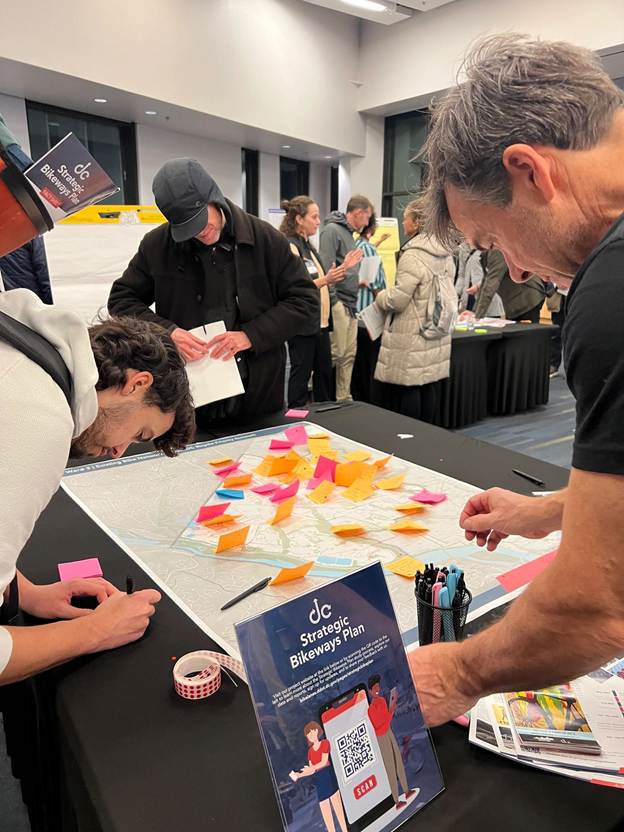
DDOT asked attendees at the Ward 3 workshop to put stickies where they want bike lanes. DDOT did not seek input from people who do not want bike lanes. This is how DDOT rigs the process in favor of cycling activists.
Share this post: